It looks ahead
The FAA describes a system that identifies potential conflicts before they occur and helps airlines and operators agree on more efficient routes and departure times.
Independent analysis · Not affiliated with the FAA
SMART is the FAA’s new AI planning layer for U.S. airspace. It does not control aircraft or replace controllers — it recommends routes to the people who do. Here is what it actually does, what the FAA says it has saved, and what it may mean for your next flight.
FAA-reported averages, applied to your traffic. Fuel and block time only.
Projected annual jet-fuel savings
Model, not forecast. FAA-reported averages multiplied by your inputs; no crew, maintenance, or passenger-time benefits. CO2 at 9.57 kg per gallon of jet fuel. Method →
The short version
SMART — Strategic Management of Airspace, Routes and Trajectories — is a cloud platform that gives controllers and aircraft operators the same view of the national airspace before flights depart.
The FAA describes a system that identifies potential conflicts before they occur and helps airlines and operators agree on more efficient routes and departure times.
Weather patterns, flight paths, traffic flow and controller staffing metrics are centralised into one platform — the FAA’s own description of the input side.
Recommendations are validated by FAA specialists, routed through the Command Center, and offered to local facility leadership — who can accept or pass. Controllers keep separation.
“SMART cannot be used to replace the critical role air traffic controllers play or take over control of an aircraft. All of SMART’s recommendations are reviewed by FAA staff.”
FAA statement, 21 September 2026 · faa.gov
Verification chain
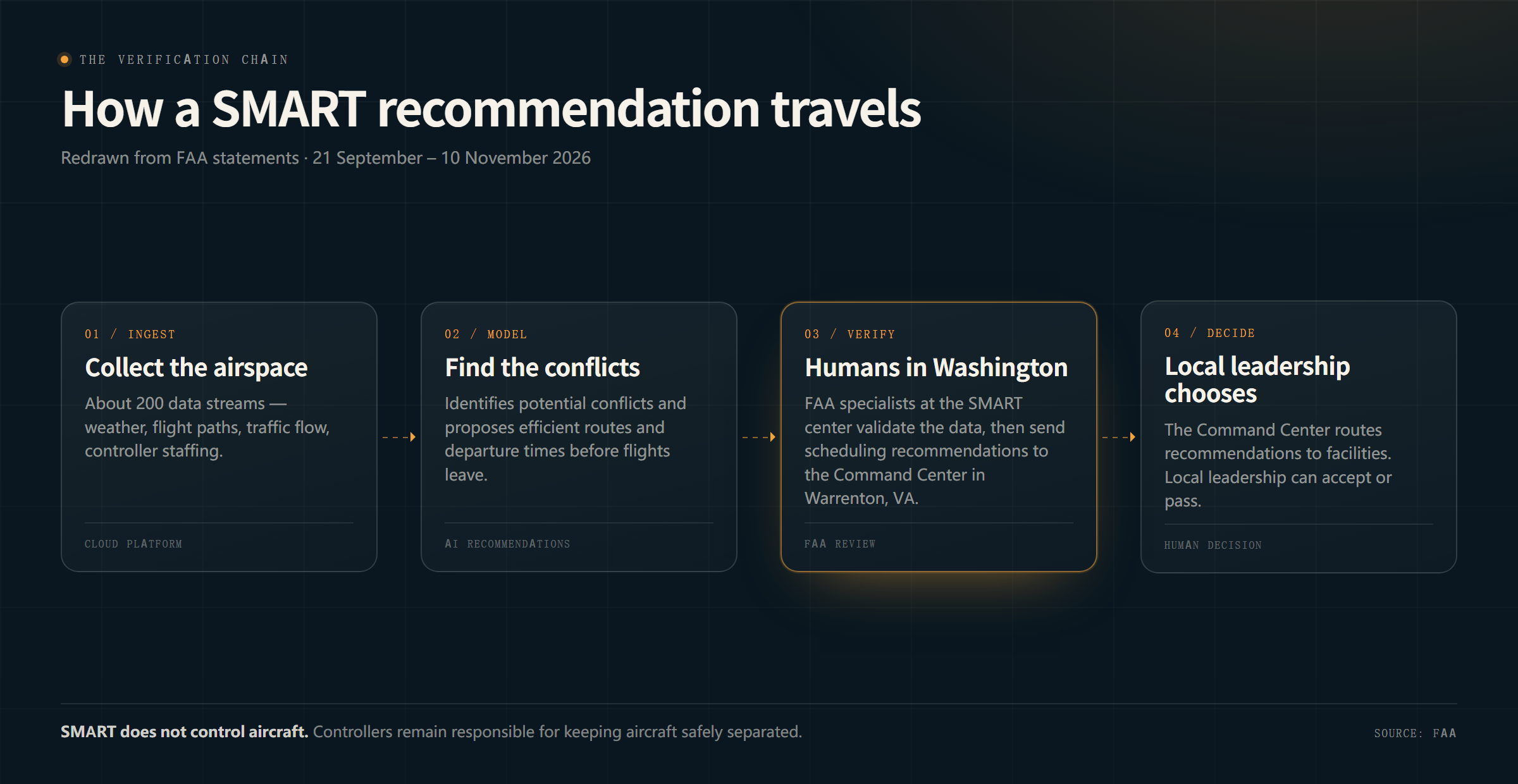
This is the part most coverage skips. SMART is not wired directly to a radar scope: its output passes through two FAA layers and one local decision before anything changes.
About 200 streams — weather, flight paths, flow, controller staffing — feed one cloud platform.
SMART identifies potential conflicts and proposes routes and departure times before flights leave the gate.
A team of FAA specialists at the SMART center in D.C. analyses and validates the data, then sends scheduling recommendations to the Command Center in Warrenton, VA.
The Command Center routes recommendations to facilities. Local leadership can accept or pass. Controllers remain responsible for separation.
Deployment
The FAA moved from a limited Washington, D.C. trial to nationwide airspace use in less than two months. The timeline, with sources.
A 12-year, $875 million award reported from contract records; the FAA release itself describes two technologies, FMDS and SMART, and does not state the value.
FAA: “began using SMART in a limited mode today in the airspace around Washington, D.C.”
A pause request at DCA, IAD and BWI, then a request that GAO audit SMART and its safety-risk process.
FAA: “will now use SMART in the airspace of all 22 centers across the country.” Nationwide airspace use is not the same as a finished system.
A nationwide ground stop lasted about four hours after communication issues. ASI and the Transportation Secretary said SMART was not involved.
Delay impact
Turn the FAA’s reported averages into a number you can inspect. The model behind the calculator is simple on purpose: every assumption is on screen.
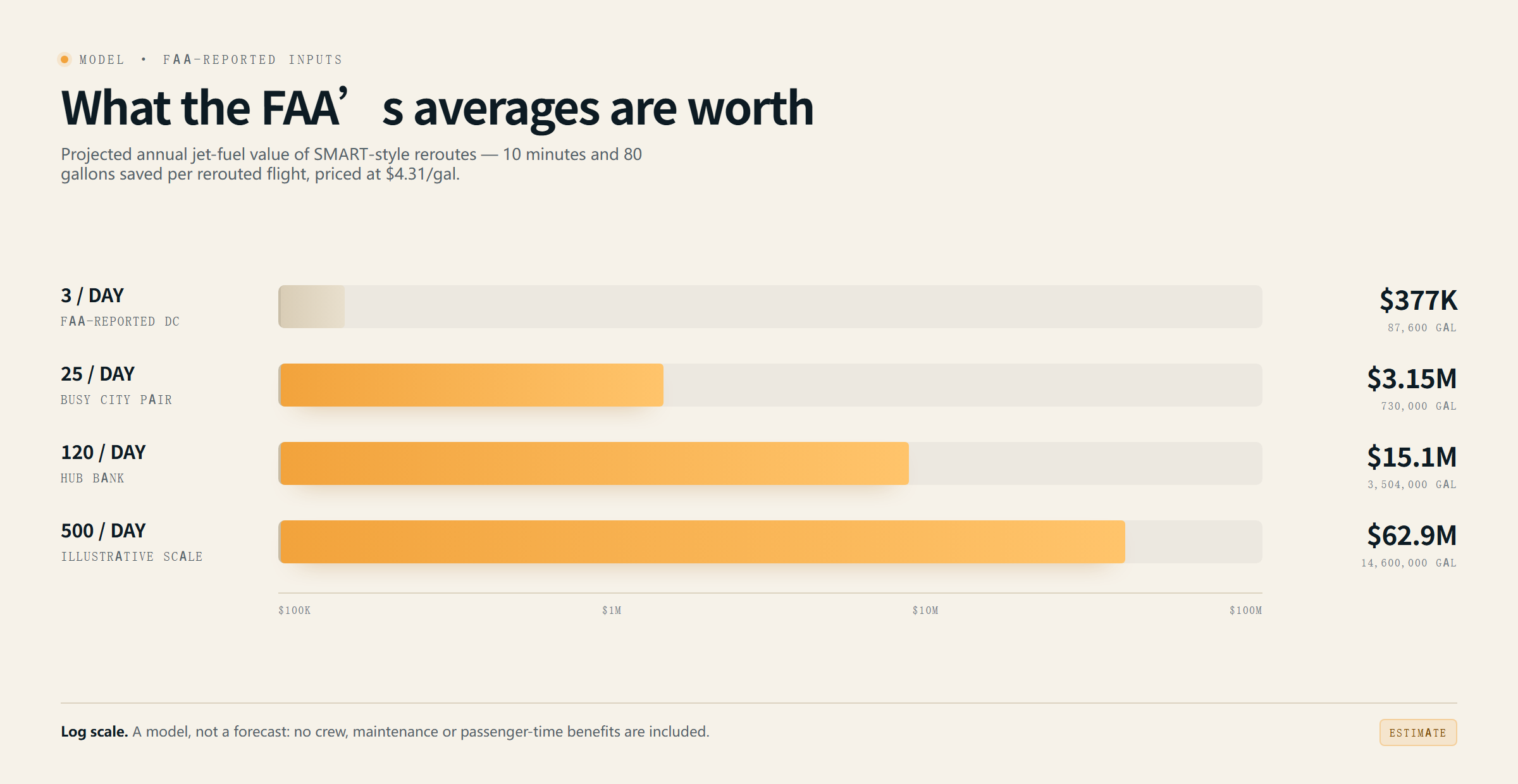
SMART is a strategic planning tool. Its effect appears in the aggregate — fewer airborne holds, earlier reroutes, less fuel burned — not as a promise about one flight number.
Scrutiny
The FAA says every recommendation is reviewed by its own staff. The controllers’ union says it was not involved. Both statements are on the record.
The FAA
The agency describes SMART as a planning layer alongside existing systems, with controllers remaining responsible for separation.
NATCA · controllers’ union
The union says it therefore “cannot speak to its effect on the air traffic control workforce.” That is non-involvement, not opposition.
House Democrats
Twenty-three members asked GAO to review the FAA’s safety-risk process, performance metrics and deployment strategy. A review has been requested, not confirmed.
Different system, real data
Ground stops, ground delay programmes, arrival and departure delays, and closures — pulled live from the FAA’s public NAS feed, with the retrieval time attached.
Primary sources
FAA statements are quoted as published. Contract values and the ground-stop sequence are attributed to the outlets that reported them, because the agency’s own releases do not carry them.
Full source listFAQ
SMART stands for Strategic Management of Airspace, Routes and Trajectories. It is a cloud-based planning platform that centralises about 200 data streams — weather, flight paths, traffic flow, controller staffing — and proposes efficient routes and departure times before flights depart. The FAA describes it as a planning layer that works alongside existing systems, not as a control system.
The FAA said on 10 November 2026 that it “will now use SMART in the airspace of all 22 centers across the country,” after starting in Washington, D.C. airspace on 21 September. That is nationwide airspace use, not a completed system: the FAA has not published a completion date for full capability. See the deployment tracker.
No — not according to the FAA’s own limits. “SMART cannot be used to replace the critical role air traffic controllers play or take over control of an aircraft,” the agency said, and “air traffic controllers remain responsible for keeping aircraft safely separated.” Recommendations are reviewed by FAA staff and can be declined by local facility leadership.
Possibly, indirectly, and not predictably. SMART targets system-wide flow: earlier reroutes, fewer airborne holds, better use of capacity. It does not control weather, crew, maintenance or gate availability, and no public data ties a specific flight’s punctuality to the tool. Treat any claim that a given flight “was saved by SMART” with care unless the airline or FAA says so.
The FAA’s figure, from 21 September to 10 November 2026: 180 flights helped to reroute, an average of 10 minutes saved per flight, and almost 80 gallons of fuel saved per flight. The agency has not published a baseline or method, so these are attributed figures rather than audited results. We use them as calculator defaults and label them as FAA-reported everywhere.
The FAA awarded Air Space Intelligence (ASI) a contract in June 2026 for two technologies: FMDS, described as the new technological backbone of the Command Center, and SMART, an enhancement within it. Reporting based on contract records puts the award at 12 years and $875 million; the FAA’s own announcement does not state the value or term.
The FAA’s safety case rests on human review at every step. Critics — including 23 House Democrats who asked GAO to audit the programme — say the reliability and safety benefits are unproven, that published performance metrics are missing, and that the union representing controllers was not involved in design, testing or implementation. We found no published independent safety review as of 14 November 2026, and the GAO review has been requested, not confirmed.
Because none is public. SMART is an internal FAA decision-support system; its recommendations are not published as data. Anyone offering a “SMART feed” is showing something else. The airport status page here uses the FAA’s public NAS status feed and says so on every result.
It multiplies four inputs — rerouted flights per day, minutes saved, gallons saved, fuel price — over a year, then converts time to block hours and fuel to CO2 at 9.57 kg per gallon. The defaults are the FAA’s reported averages. Nothing is sent to a server; the arithmetic happens in your browser. Full assumptions are in the methodology.